If you’re planning a trip to Mexico for Day of the Dead, choosing where to go matters almost as much as choosing when to go.
The celebration takes place across Mexico, but it doesn’t look the same everywhere. In some places, families gather around candlelit graves through the night. In others, the streets fill with public events, parades, altars, music and neighborhood celebrations.
For travelers, that means there isn’t one single Day of the Dead experience.
Michoacán, Mexico City, Oaxaca, Puebla and the Huasteca region all offer something different. The right destination depends on the kind of experience you want, how much time you have and how comfortable you are with more complicated logistics.
This guide focuses on the practical side: where to celebrate Day of the Dead in Mexico, what you can expect in each destination, how long to stay and how to plan the trip.
Looking for the cultural background first? Read our guide to Day of the Dead in Mexico to learn about the tradition, the ofrenda, La Catrina and its history.
🎟️ Already know where you’re going?
Book your Day of the Dead experience now, spots fill up fast as November 1–2 approaches.
Here are some of the destinations worth considering:
- Lake Pátzcuaro, Michoacán — for candlelit cemetery vigils and Purépecha traditions
- Mexico City — for large public events, parades and monumental altars
- Oaxaca — for cemetery vigils, comparsas and celebrations across the surrounding communities
- Huaquechula, Puebla — for distinctive monumental altars and a smaller-town experience
- Huasteca Potosina — for Xantolo, with music, dance and Indigenous regional traditions
- San Miguel de Allende — for a more urban, artistic celebration
The important thing is not to treat these destinations as interchangeable. They offer different ways of experiencing the same season.
1. Lake Pátzcuaro, Michoacán
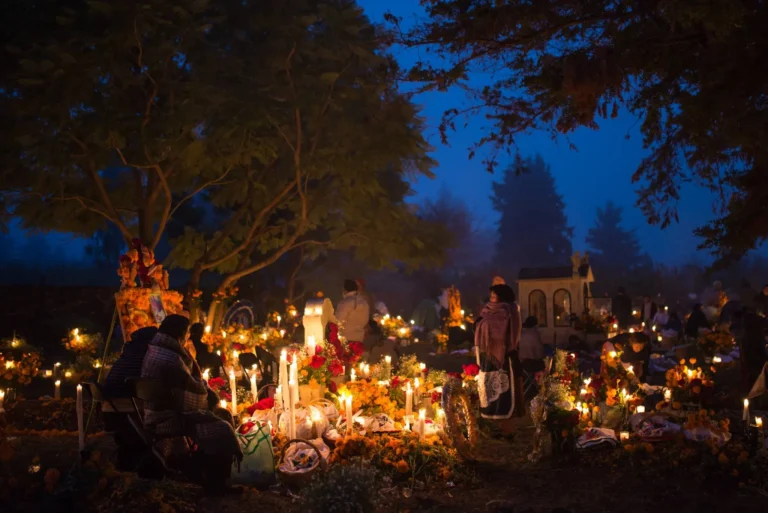
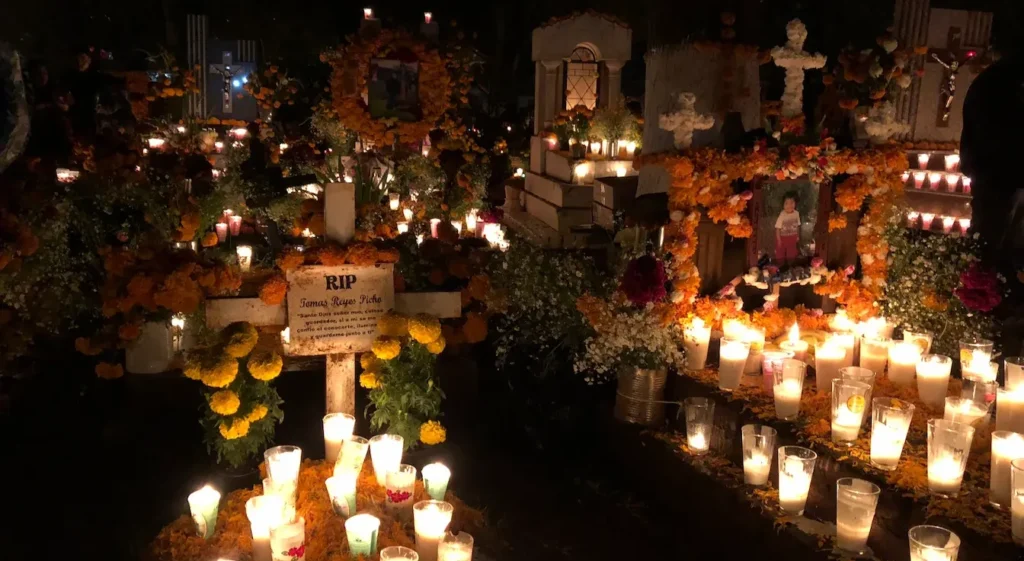
If what you imagine when you think of Día de Muertos is candlelight, cemeteries, flowers and families keeping vigil through the night, Lake Pátzcuaro is one of the places to look at first.
The communities around Lake Pátzcuaro have strong Purépecha traditions, and the celebration centers around family remembrance and cemetery vigils.
The best-known destination is Janitzio, an island in Lake Pátzcuaro, but it is only one part of the region.
Other communities around the lake have their own traditions and atmospheres, including Tzintzuntzan, Ihuatzio, Cucuchucho, Tzurumútaro and Arocutín.
The experience can feel very different from a large city event. Instead of watching one central parade, you’re moving through communities where families are honoring their own loved ones.
Michoacán has a lot more to offer beyond Día de Muertos too. See our complete Michoacán travel guide for Morelia, the Monarch Butterfly Biosphere and the state’s Magical Towns.
What to expect
- Candlelit cemeteries
- Ofrendas and decorated graves
- Overnight vigils
- Purépecha cultural traditions
- Heavy crowds in the best-known locations
- Dark roads and more complicated transportation between villages
- A quieter, more intimate experience in smaller communities
Where to stay
Pátzcuaro is the most practical base if your priority is exploring the lake communities.
Morelia is another option, particularly if you want more hotel inventory or easier airport connections. Morelia International Airport is roughly an hour from Pátzcuaro by road.
🎟️ Book the Lake Pátzcuaro Day of the Dead Experience
Skip the logistics headache. A guided night on the lake takes care of transportation, timing and etiquette, so you can focus on the experience instead of finding your way around unfamiliar villages after dark.
Check availability →How long should you stay?
Give yourself at least two nights if Lake Pátzcuaro is the main reason for your trip.
One night can work, but it leaves very little room for transportation, crowds and the fact that the most meaningful experiences happen after dark.
Important: the most significant vigil period in the Lake Pátzcuaro region centers on the night of November 1 into November 2, although individual communities have their own calendars and activities.
A note about visiting cemeteries
These are active family spaces, not tourist attractions.
If you visit a cemetery during the celebration, ask before photographing people or private altars, keep your voice down and follow any local instructions.
2. Mexico City
Mexico City offers a completely different experience.
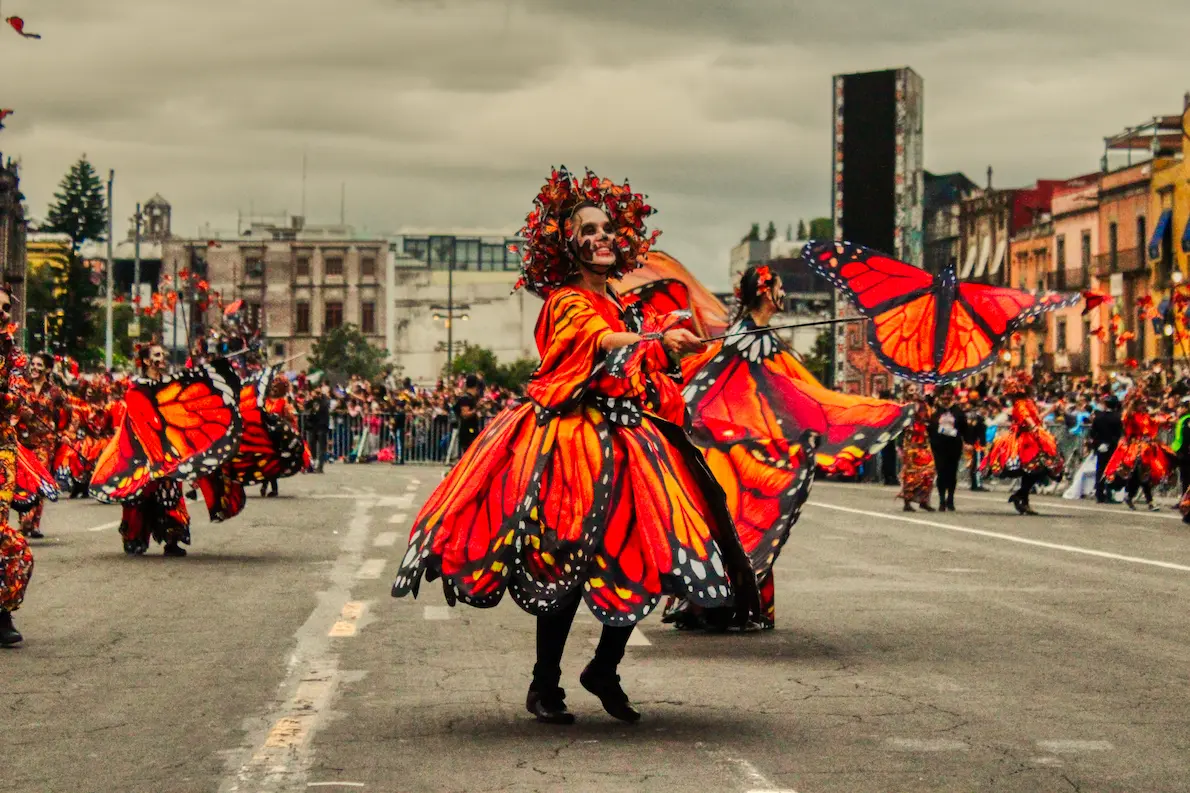
Here, Día de Muertos becomes a large-scale urban celebration, with public events, monumental ofrendas, exhibitions, decorated spaces and the famous Catrina imagery associated with the city’s contemporary festivities.
It is also one of the easiest destinations logistically for international visitors.
You can stay in one city and combine Día de Muertos activities with museums, restaurants, historic neighborhoods and other Mexico City attractions. If this is your first time in the capital, our Mexico City travel guide covers neighborhoods, museums and where to stay.
What to expect
- Large public celebrations
- Monumental altars
- Catrina-themed events
- Public performances and cultural programming
- Crowded streets
- Museums and seasonal exhibitions
- A much more urban atmosphere than the Lake Pátzcuaro communities
Mexico City’s modern Day of the Dead parade began in 2016, inspired by the opening scene of the James Bond film Spectre, as PBS NewsHour reported at the time. So it shouldn’t be confused with an ancient tradition that has existed in the capital for centuries. The parade is a contemporary public celebration that has become part of the city’s Day of the Dead season.
🎟️ Book the Mexico City Day of the Dead Experience
See the monumental altars and the parade route with a local guide who knows where to stand, when to arrive and how to avoid the worst of the crowds.
Check availability →What about Mixquic?
San Andrés Mixquic, in the southeast of Mexico City, is worth considering if you want to experience a cemetery-centered tradition without leaving the capital.
This can be a useful middle ground: you can base yourself in Mexico City while visiting a smaller community for part of the celebration.
How long should you stay?
For a first trip, 3–4 nights gives you enough time to experience seasonal events without making Día de Muertos your entire Mexico City itinerary.
The exact public-event schedule changes from year to year, so check Visit Mexico’s official Day of the Dead events lineup for Mexico City before booking around a specific parade or event.
3. Oaxaca
Oaxaca is another major destination for Day of the Dead, and the experience extends beyond Oaxaca City.
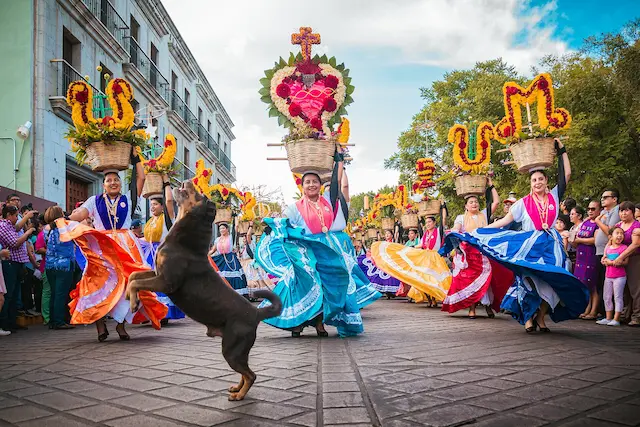
The city and surrounding communities come alive with cemetery vigils, comparsas, altars, markets and neighborhood celebrations.
One advantage of choosing Oaxaca is that you can combine a city stay with visits to nearby communities, giving you several different experiences without changing your main hotel every night.
Nearby cemeteries and communities are an important part of the seasonal experience. Travel sources specifically highlight places such as Xoxocotlán and other surrounding communities for cemetery visits and celebrations. For the rest of what to do in the city, see our Oaxaca travel guide.
What to expect
- Candlelit cemetery visits
- Comparsas and street processions
- Ofrendas
- Markets and seasonal food
- Traditional music
- Celebrations in surrounding towns
- A combination of urban and community-based experiences
How long should you stay?
Plan for 3–4 nights if Día de Muertos is the main purpose of the trip.
Oaxaca also works particularly well if you want to combine the celebration with food, markets, archaeology or other regional experiences.
One important distinction
Don’t plan your Oaxaca trip around Oaxaca City alone.
Some of the experiences travelers are specifically looking for happen in surrounding communities, so your transportation plan matters.
4. Huaquechula, Puebla
Huaquechula offers a smaller-scale experience centered around one of the most distinctive elements of the region: its large ceremonial altars.
This is a very different proposition from Mexico City’s huge public celebrations.
If you’re interested in seeing how Day of the Dead traditions are expressed within a smaller community, Huaquechula is worth researching.
It can also be incorporated into a broader Puebla trip rather than requiring you to build an entire vacation around the town.
Because specific activities and access can vary, check the local calendar before traveling.
5. The Huasteca Potosina: Xantolo
In the Huasteca region, Day of the Dead is known as Xantolo.
The celebration has its own regional identity, with music, dance, altars, costumes and community events.
The Huasteca extends across several states, including San Luis Potosí, Hidalgo, Veracruz and Tamaulipas, so this isn’t a single-city festival.
In the Huasteca Potosina, communities organize their own activities, and the exact program can vary by municipality. San Luis Potosí’s state government describes Xantolo as a tradition that has positioned the state on the country’s cultural map, with families preparing altars, food, flowers and candles.
What makes Xantolo different?
Rather than focusing primarily on the imagery most international visitors associate with Día de Muertos, Xantolo has its own regional traditions, including music, dance and community celebrations.
It’s particularly interesting for travelers who want to see a regional Indigenous tradition rather than a large tourist-oriented city event.
How long should you stay?
Plan additional time for transportation.
The Huasteca is spread across multiple municipalities, so 3–4 nights is a more realistic starting point if you’re planning to explore beyond a single town.
6. San Miguel de Allende, Guanajuato
San Miguel de Allende offers yet another version of the season, with public events, art, costumes, installations and celebrations integrated into the historic city.
The city is also home to La Calaca Festival, an event that has become part of San Miguel’s contemporary Day of the Dead season. Visit Mexico includes San Miguel de Allende among the country’s notable destinations for the celebration.
This is a good option if you want to combine Day of the Dead with a broader central Mexico trip. For everything else to do in town, check our San Miguel de Allende travel guide.
It is less about spending the entire night in a rural cemetery and more about experiencing the celebration within a beautiful colonial city with a strong arts and events scene.
Which Day of the Dead Destination Should You Choose?
Instead of asking which destination is “the best,” start with the experience you actually want.
| If you want… | Consider… |
|---|---|
| Candlelit cemetery vigils and Purépecha traditions | Lake Pátzcuaro, Michoacán |
| Large public events and Catrina celebrations | Mexico City |
| Cemeteries, comparsas and surrounding communities | Oaxaca |
| Distinctive monumental altars in a smaller community | Huaquechula |
| Music, dance and regional Indigenous traditions | Huasteca Potosina / Xantolo |
| Art, events and a colonial-city setting | San Miguel de Allende |
There is no need to force every destination into the same definition of Day of the Dead. The differences are exactly what make traveling during this season interesting.
Mexico City vs. Michoacán vs. Oaxaca
For many international travelers, the practical decision eventually comes down to these three.
| Lake Pátzcuaro | Mexico City | Oaxaca | |
|---|---|---|---|
| Main experience | Cemetery vigils and community traditions | Large public celebrations | Cemeteries, comparsas and communities |
| Atmosphere | Smaller towns and villages | Large, urban and crowded | City + surrounding communities |
| Logistics | More complicated | Easiest | Moderate |
| Ideal base | Pátzcuaro or Morelia | Mexico City | Oaxaca City |
| Recommended time | 2–3 nights | 3–4 nights | 3–4 nights |
| Best suited to | Travelers seeking a lake-region/community experience | Travelers who want events and city life | Travelers who want a mix of city and community experiences |
Think about the type of night you want to have, not just the destination name you recognize from Instagram.
How Many Days Do You Need for a Day of the Dead Trip?
You don’t necessarily need a two-week vacation to experience Día de Muertos.
| Duration | Best for | Sample plan |
|---|---|---|
| 2–3 days | Focusing on one destination and experiencing the main celebration | Day 1: arrive and explore. Day 2: main Day of the Dead activities. Day 3: extra community or cultural experiences, then departure. |
| 4–5 days | More flexibility and less rushing | Arrive before the busiest night, explore by day, experience the main celebration, and leave without cramming everything into 24 hours. |
| 7+ days | Combining Día de Muertos with a longer Mexico itinerary | Mexico City + Oaxaca, or Mexico City + Michoacán. Avoid moving between destinations during the busiest dates (Nov 1–2), when transportation and accommodation get more complicated. |
When Should You Book Your Day of the Dead Trip?
If you’re traveling specifically for Día de Muertos, don’t treat it like a normal low-season Mexico trip.
Hotels in the most popular destinations can become difficult to find as the dates approach, particularly around November 1 and 2. Travel coverage for 2026 is already emphasizing the need to book popular destinations well ahead of the holiday period.
I would prioritize your bookings in this order:
1. Choose your destination
Don’t book flights first and figure out the celebration later.
Decide whether you want Michoacán, Mexico City, Oaxaca or another region.
2. Book your accommodation
This is particularly important if you’re traveling to Pátzcuaro, Oaxaca or another destination with limited accommodation during peak dates.
3. Plan transportation
This matters even more in regions where celebrations happen in several villages.
4. Book tours if you need one
A local guide can be particularly useful in places where roads are dark, unfamiliar or poorly marked at night.
5. Leave some flexibility
Don’t schedule every hour.
Some of the most meaningful moments may happen outside the official events calendar.
Do You Need a Tour for Day of the Dead?
Not necessarily.
In Mexico City, independent travelers can easily explore many public celebrations using the city’s extensive transportation network.
In Oaxaca, you can also travel independently, although transportation becomes more important if you want to visit several surrounding communities.
Michoacán is different.
If you’re planning to visit several Lake Pátzcuaro communities at night, a local guide or organized tour can make the logistics considerably easier.
This is especially relevant for smaller villages where roads may be dark, signage limited and parking or traffic complicated during the busiest hours.
And there’s another reason to consider a guide: context and etiquette.
A good local guide can explain where visitors should stand, when photography is appropriate and how to move through a community without treating a family vigil like a tourist attraction.
Where Should You Stay?
Your accommodation strategy depends heavily on your destination.
Lake Pátzcuaro
Stay in Pátzcuaro if you’re focusing on the lake communities.
Consider Morelia if you want more hotel options or are combining the trip with time in the city.
Mexico City
Stay in a neighborhood that makes sense for the activities you want to attend rather than choosing solely based on the cheapest room.
Remember that large events can mean traffic closures and crowded public transportation.
Oaxaca
Oaxaca City is the most practical base for most visitors, particularly if you’re planning day trips to surrounding communities.
What Should You Pack?
Day of the Dead takes place in late October and early November, but temperatures can change considerably depending on the destination and altitude.
For most trips, pack:
- Comfortable closed-toe shoes
- Layers for cool nights
- A light rain jacket
- Small flashlight or phone light
- Portable battery
- Cash in Mexican pesos
- Small crossbody or secure day bag
- A reusable water bottle
For Michoacán in particular, don’t underestimate the cold at night.
You’ll also spend more time outdoors and standing than you might expect.
Comfortable shoes are much more useful than an elaborate Day of the Dead costume.
Day of the Dead Travel Etiquette
This is perhaps the most important part of planning the trip.
Remember that you’re visiting a cultural and family tradition, not a theme park.
Ask before taking photographs
Especially when photographing people, graves or private ofrendas.
Don’t interrupt a family vigil
Give people space around graves and avoid walking through private altars simply because they look photogenic.
Keep your voice down in cemeteries
A cemetery may be busy without being a party.
Don’t assume costumes belong everywhere
Face paint and elaborate Catrina costumes are common at public events, particularly in Mexico City.
That doesn’t mean they are appropriate for every cemetery or community.
Follow local instructions
If an area is restricted or visitors are asked not to enter a particular space, respect it.
Buy from local artisans when possible
Markets and communities around the celebrations are an excellent opportunity to support the people whose work helps make the season what it is.
What Is the Best Day of the Dead Itinerary?
There isn’t one itinerary that works for everyone.
But if you’re building a trip specifically around the celebration, I’d structure it around one main destination rather than trying to see all of Mexico in a few days.
Option 1: Mexico City
3–4 nights
Use Mexico City as your base and combine public celebrations with museums, neighborhoods, food and a possible visit to Mixquic.
Option 2: Oaxaca
3–4 nights
Stay in Oaxaca City and use selected days or nights to visit surrounding communities.
Option 3: Michoacán
2–3 nights
Base yourself in Pátzcuaro and dedicate your main night to the Lake Pátzcuaro communities.
If you have additional time, add Morelia rather than trying to squeeze several distant regions into the same trip.
Frequently Asked Questions
Where is the best place to celebrate Day of the Dead in Mexico?
There isn’t one destination that offers the same experience for every traveler.
Lake Pátzcuaro is known for its cemetery vigils and Purépecha traditions, Mexico City for its large public celebrations, Oaxaca for cemetery traditions and comparsas, and the Huasteca for Xantolo.
The right choice depends on the type of experience you want.
Where should I go for a traditional Day of the Dead experience?
If your priority is experiencing community-based cemetery vigils and Indigenous regional traditions, look beyond Mexico City’s major public events.
Michoacán and Oaxaca are two of the most prominent regions to research, while Xantolo in the Huasteca offers another distinct regional tradition. Visit Mexico’s official Día de Muertos hub highlights all of these regions as different ways to experience the season.
How many days do I need for Day of the Dead in Mexico?
For one destination, 2–4 nights is a practical range.
If you’re combining destinations, allow more time and avoid packing the itinerary too tightly around November 1 and 2.
Is Day of the Dead celebrated only on November 1 and 2?
November 1 and 2 are the central dates, but many destinations have activities before and after those dates.
The exact calendar varies by community, so check the local program for the year you’re visiting.
Do I need to book a Day of the Dead tour?
No.
You can experience many celebrations independently. However, a local guide can be useful when visiting several communities, especially in regions such as Lake Pátzcuaro where nighttime transportation and local etiquette require more planning.
Can I visit a cemetery during Day of the Dead?
Yes, in places where visitors are allowed.
But remember that cemeteries are active family spaces during the celebration. Ask before photographing people or private altars, avoid disturbing ceremonies and follow local instructions.
What should I wear for Day of the Dead?
Comfortable shoes and layers are more important than costumes.
If you’re visiting cemeteries at night, bring a warm layer and a small flashlight or phone light. Conditions can become surprisingly cold in some high-altitude destinations.
Final Thoughts
One of the best things about traveling through Mexico during Día de Muertos is realizing that there isn’t a single version of the celebration.
A night beside a candlelit grave in Michoacán feels completely different from walking through a Mexico City parade. Oaxaca’s surrounding communities offer another experience, while Xantolo brings its own regional traditions to the Huasteca.
So don’t start your planning by asking:
“Where is the best place to celebrate Day of the Dead?”
Start with:
“What kind of experience do I want?”
Once you answer that, choosing where to go becomes much easier.
And if you’ve decided on Lake Pátzcuaro, start with our complete Michoacán travel guide to plan the rest of your trip.